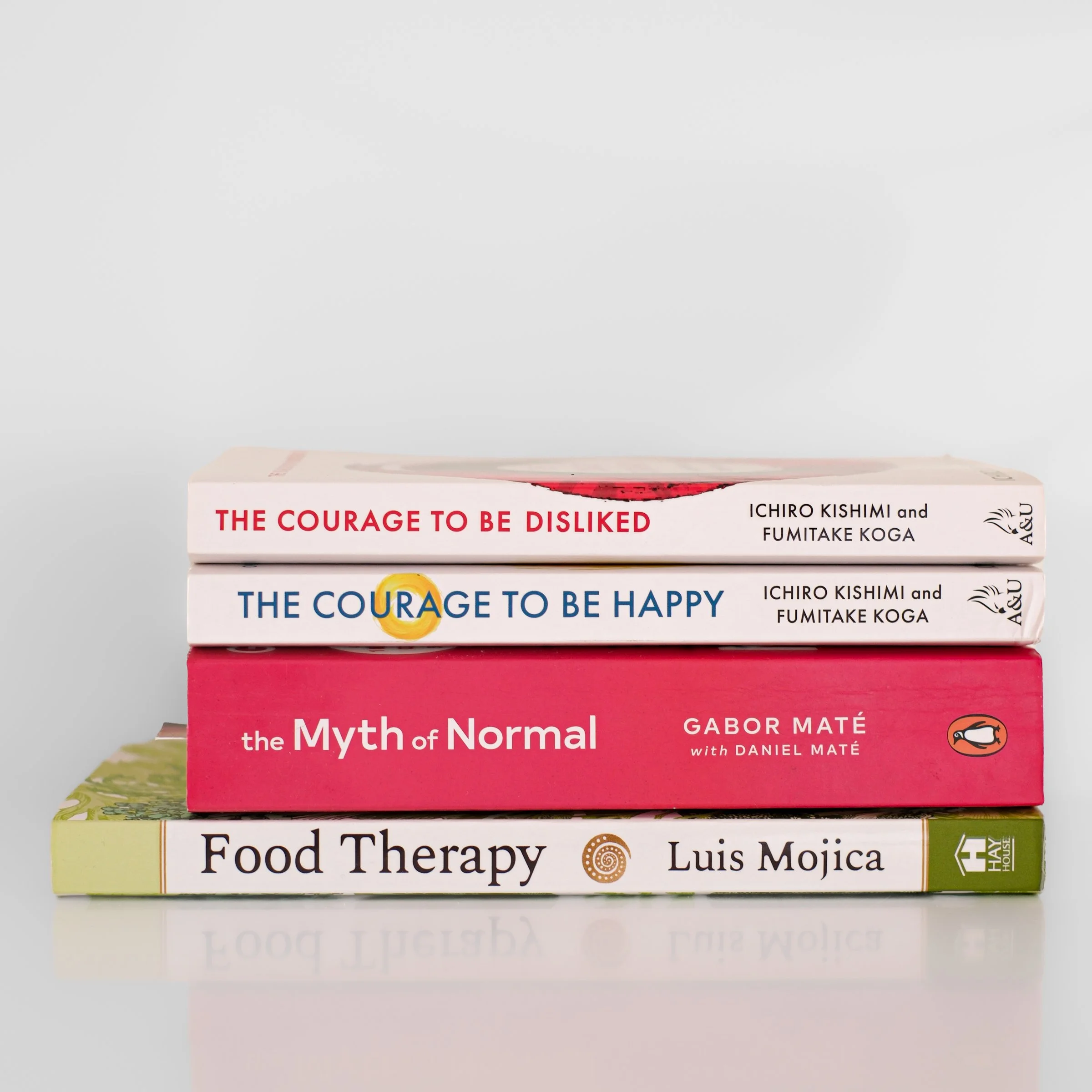
I love the way Luis Mojica describes trauma—not as a pathology, but as a saving grace, one showing us where to turn our attention.
And I’m moved by the way Gabor Maté invites all of us who have suffered harm and all of us who have caused it (a Venn diagram shaped like a circle?) to not enmesh responsibility with guilt or shame.
And I’m intrigued to learn about Ichiro Kishimi and Fumitake Koga’s unusual guidance to cultivate profound acceptance for the past and embrace a life of honesty and service.
The “self help” shelf sometimes elicits mockery, but I bet there’s a book that can help with that. I wouldn’t know—my struggles are way more earnest. What are they? Increasingly all signs past and present point to what’s known as CPTSD—early-life stress so pervasive that I was unable to orient my relational and emotional growth around a baseline of trust and safety. And afterwards—a domino sequence of trauma-rooted and further traumatizing events (many of them apparent “choices”) by the emotionally immature person I long was, one with no working inner compass for avoiding harm. How am I so sure? It’s the one hypothesis that makes decades of mystery physical ailments, baffling emotional problems, and unhappy relationships coalesce into a something I can grasp. And solve! Books help, especially since I’ve loosened so many of the knots inside that I am increasingly able to weave anew what I believe to be true about myself and the world.
My entire reading list for a better life is thankfully not the subject of this post, but it’s easy enough to say which books have recently helped me redefine my relationship to the ways I respond to perceived threat. Or which three authors have recently helped me become less conflict-avoidant at last, and more able to stay aware of what I’m feeling in real time.
I recommend The Courage to Be Disliked (and its sequel, The Courage to Be Happy) for the way the authors patiently ask and answer questions I never would have considered—ones that guide toward better boundaries, fewer excuses, and the life-affirming effort of honoring community. Do I agree that “trauma doesn’t exist”?—not exactly, but I can say that when this book suggests this controversial idea I find myself curious, emboldened, and open to listening. The writing assumes the form of a simplistic dialogue between a wise elder and a hot-headed youth. My sense is that this storybook style lends itself uniquely well to shifting a reader’s so-called “core beliefs”—at least that’s how things went for me. The two books are essentially an intro to the philosophy of Austrian psychologist Alfred Adler, the most obscure but no less influential contemporary of Sigmund Freud’s and Carl Gustav Jung’s. Of note is the clear Japanese twist that leaves me wondering what it might be like to learn about Adler’s ideas by reading, say, Adler. I especially enjoyed learning about the differences between work relationships, friendships, and the romantic partnership (this comes in the second book and keeps being applicable in all sorts of ways to my everyday life).
I first heard of Gabor Maté several years ago in the context of his theories about the ADD and ADHD. Right away I liked how Maté suggested the causes are environmental—insufficient attunement by caregivers and brain injury from blinking screens—and support the idea that much of what we our culture pathologizes consists of the body’s natural responses to unnatural conditions. That’s the subject of Scattered Minds. This summer my choice was between the now classic When the Body Says No and the latest The Myth of Normal, an indictment against the materialism and isolation of late capitalism, which frames quite nearly all illness—especially self-harm, addiction, and so-called mental illness—as a normal human reaction to intolerable stress, particularly when it comes to highly sensitive people and children. I read the latter book and I chose well, in part because the themes of chronic illness and the attention deficit epidemic are explored in dedicated well-argued chapters.
What captures my heart is the author’s own sober accountability regarding his children’s childhood suffering. Maté tells us how hurt people hurt people and how culture impacts emotional development, then he shows us what to do about what you did when you didn’t know any better. What I love about Myth is not just the message but also the writing, a team effort by Maté the elder and his writer son, Daniel Maté, whose decision to collab with bestselling dad tells me more than you know.
Food Therapy is the first book by the creator of Holistic Life Navigation, an Instagram profile emphasizing the impact of balancing foods on the body’s stress engine and radical acceptance for the limits of capacity—both our own and the capacity of those who have caused our suffering. I expected Mojica’s book to deal mainly in dietary wisdom—how to eat for emotional ease, what to eat to soothe a system accustomed to digestive stress, why Mojica advocates for eating beans—but I discovered a guide as interdisciplinary as emotional life itself. I’ll share some excerpts from pages 232 and 233 now—insights so liberating I feel they’ve already washed away whatever it was I believed about so-called “self-sabotage” before this benevolent summer came along.
I grew up with “mind over matter” as a dominant cultural ideology. Most self-help at the time was about bypassing or dominating the body with the desires, goals, and objectives of the mind. (...) I think the most life-changing discovery I’ve ever made was the distinction between my desire and my capacity. Are they congruent? When the answer is no, I’m left with two simple questions that can lead me toward more clarity and balance: (1) What support does my body need to reach for my desires? (2) When a desire is beyond my capacity, how do I support myself to grieve the lost desire or unreachable goal?
What a time this is! For reading. And for making decisions I couldn’t imagine making prior to the Year of the Fire Horse. And for figuring out that anger really is just trying to protect me, healthy conflict really is okay. It may seem like I’m on sick leave a lot of the time, but by now it’s pretty clear that I’ve never been better.
Note: The books by Luis Mojica and Gabor Maté I’ve read recently. The Courage books I read in the summer of 2025, but they still feel like a recent discovery—and since I passed along my pencil-marked versions to a friend, I’m likely to re-read (and re-annotate) Kishimi and Koga while my fascination with these unusual books is still alive.