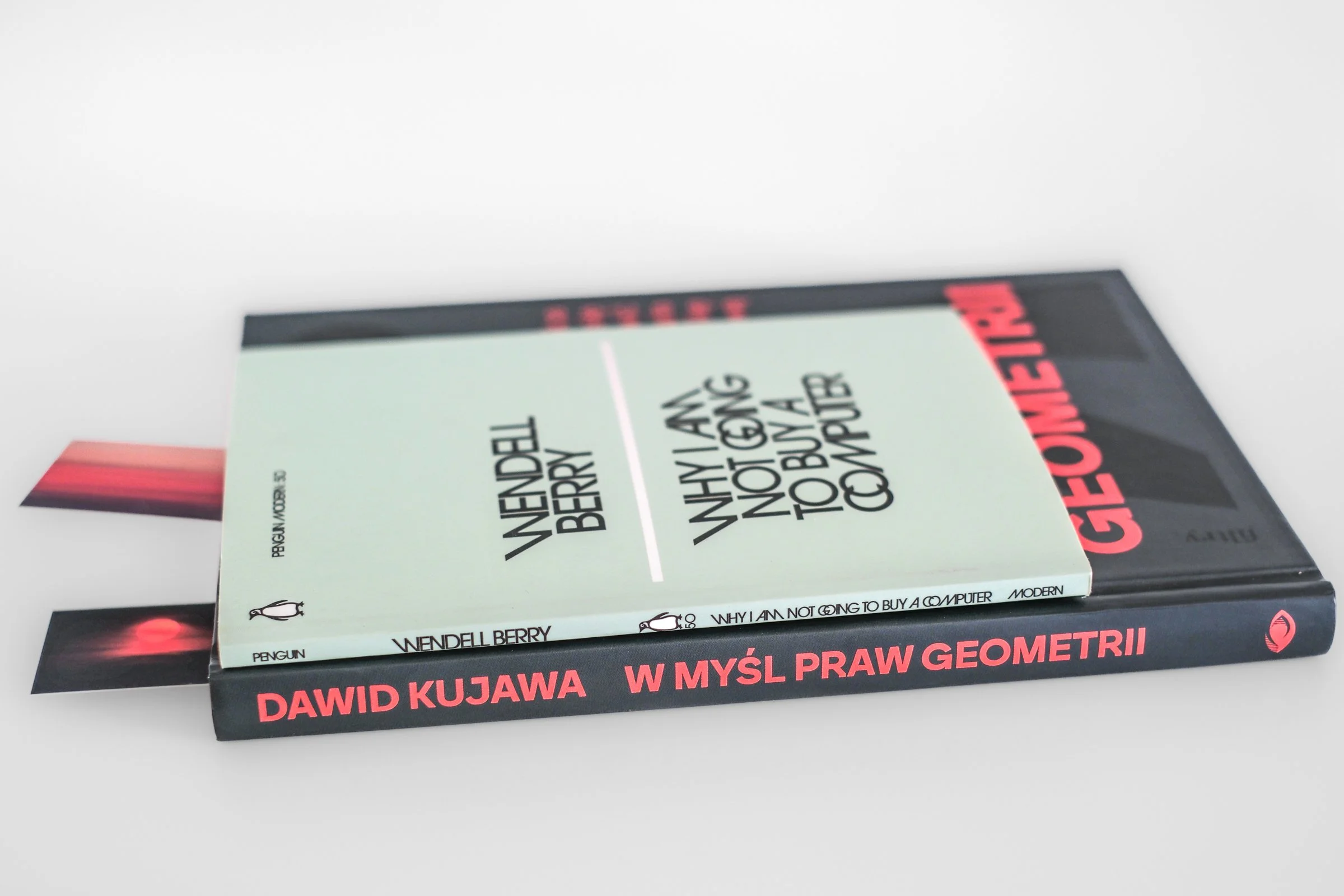
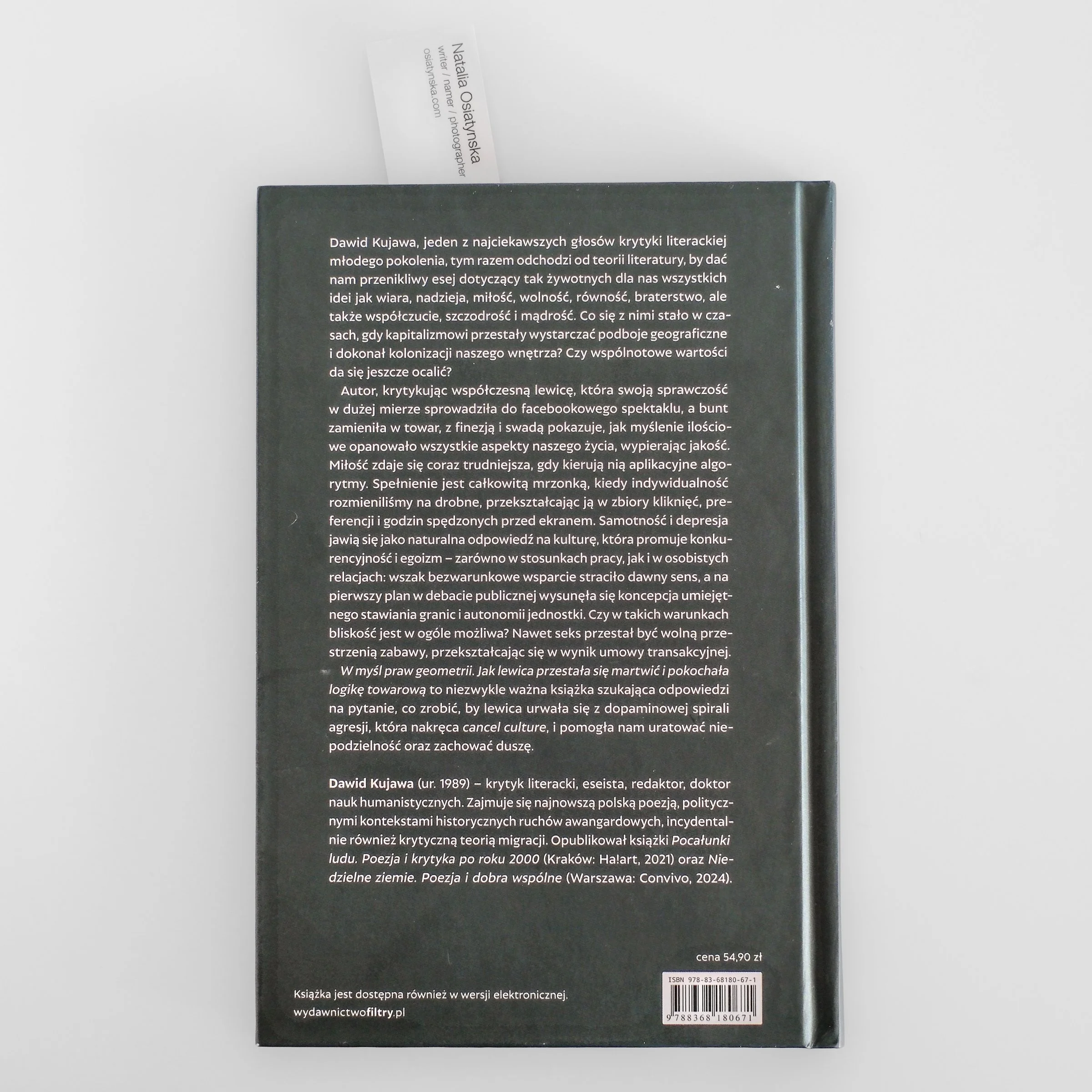
Any fan of David Kujawa’s beautiful book is likely to delight in the author’s fluid lucidity and the cool elegance of that cover. And if you have a contrarian streak you may also enjoy how your fondness for this book goes against the critical backlash. The same boring sarcasm that tends to dominate political discourse in Poland is now being launched left and right—generally by an offended left—against Kujawa’s succinct and illuminating read, which may have its sins, but is remarkably not-guilty of this one. In fact, the way Kujawa manages insight, irony, grief, helplessness, and plenty of wit without resorting to sarcasm is a rare feat, though apparently one awarded no points by the people counting.
I am not especially qualified to review a book such as this. I am no literary critic, nor am I versed in the political science and economic theory required for the task. But what I might be is this book’s ideal reader—one underinformed with regard to the perils of capitalism, open to the author’s lessons, and willing to be acted upon by them. How? This I don’t know, but if my mission is to sprinkle a dash of Marxism onto how I live, I’m curious to see how that unfolds, given all the ways I’ve personally won (or “won”?) the neoliberal lottery. And if the goal is to get a handful of unlikely others to give this book a shot, may this blog entry nudge things along, even if all I can offer is some lore and trivia.
First, that title. What a splash it makes. Here’s my unauthorised translation: Parceled Out: How the Left Loosened Up and Said Yes to the Commodification of Life. (And here’s the literal gloss: By Geometric Rules: How the Left Stopped Worrying and Fell in Love With Comodity Logic.) Already I’m a dissident, it appears, because while actual Reviewers With a Podcast are on record griping about the title’s weird obscurity, I’m delighting in the way it sparks wonder, provokes a search, and acquaints me with English poet William Wordsworth’s outsized autobiographical work The Prelude from 1850. It turns out those “geometric rules” warn against the rigidities of rationalism. (But who shall parcel out / His intellect by geometric rules, / Split like a province into round and square? / Who knows the individual hour in which / His habits were first sown, even as a seed? / Who that shall point as with a wand and say / “This portion of the river of my mind / Came from yon fountain?” Thou, my Friend!)
Next—that swoon-worthy cover. Designed (like almost everything from Filtry) by Marta Konarzewska, it is the perfect example of the way great design is always more than the sum of the parts, probably because it boldly splits the meaning-making between the artist’s art and the viewer’s symbolic imagination. Here, a mechanistic humanoid stencil in black flatly fills a smooth petrol background. The figure is facing left (or maybe heading backwards?). What’s alive are the words, rendered in a high-gloss fluorescence that makes those letterforms appear to hover and glow. This is Pantone 805 U, by the way, the hard-to-photograph print equivalent of a controlled substance. My sense is that all of this visual/textual signifying says and does exactly what Kujawa’s book says and does, all without overstating—or missing—a thing.
As for the message, two main themes are apparent. One theme posits that the commodification of our emotional lives explains why capitalism refuses to collapse, despite having exploited all of the expected natural resources required to satisfy its overconsumption. The other theme reveals the hidden consumerism in all manner of seemingly anti-consumerist thinking and behavior. Those critics I mentioned early on? Some are dissecting just how wrong Kujawa’s definition of “the left” seems to be, or how hypocritical we ought to find the author’s own virtue signaling (allegedly most apparent whenever he is knocking down virtue signaling). But these are not barriers for me, maybe because I don’t need Kujawa to be right or wrong, or above his own categories of reproach. I’m simply thrilled that he has pulled back a curtain I hadn’t noticed, showed me where to point my own pointed questions. One thing is certain—what I suspect Slavoj Žižek’s repellance long ago rendered completely off-limits for me, Kujawa has restored to accessibility.
Stylistically this book appealed to me in a way few Polish books do, and since you are reading this in English it’s likely you might have to just trust me on this one. I already mentioned the way Kujawa uses practically no passive-agressive sarcasm. He also manages to avoid those grammatical nonparallelisms that bother me in so much contemporary writing. Most importantly, Kujawa’s word choice is clearly that of someone who dislikes platitudes and bookish automatisms like “innymi słowy”. (A rapper on Tinder told me once that a rhyme is no good if you see it coming. I say the same goes for non-rhymes and clearly Kujawa knows.)
If you’re curious about that little matching bookmark in the photo, here’s the scoop. It’s actually one of my own business cards—a Minicard from the user-friendly online print service Moo, which I use to turn many of my photos into business cards and postcards. I would find it mentionable if I had merely paired book and bookmark for maximum visual cohesion, but what happened was far more remarkable. You see, the books were in a stack, the one first in line on top of ones I was planning to read next. One night I reached for the top book and that’s when my little card with the 805 U sun against petrol sky dropped onto the cover of W Myśl Praw Geometrii. It turned out my friend Magda had marked her place in the book she loaned me with one of my cards many months earlier. My card as a bookmark was one surprise, the perfect pairing of photo and cover was another.
You know what else was pure serendipity? Coming across Wendell Berry’s Why I Am Not Going to Buy a Computer on Vinted while reading Kujawa. That title alone would have had me researching Berry even if this hadn’t been one of those irresistible Penguin Modern editions with the electrifying typography. So I had just finished Kujawa when the Berry book arrived and unless you’ve read Berry right after reading Kujawa you cannot possibly begin to imagine the synchronous wonder I experienced.
Kujawa’s observations might be bleak, but my experience as a reader leaves me grateful—hence this post, and hence one final cheer of an ending.