A Few Words in Support of My Recommendation
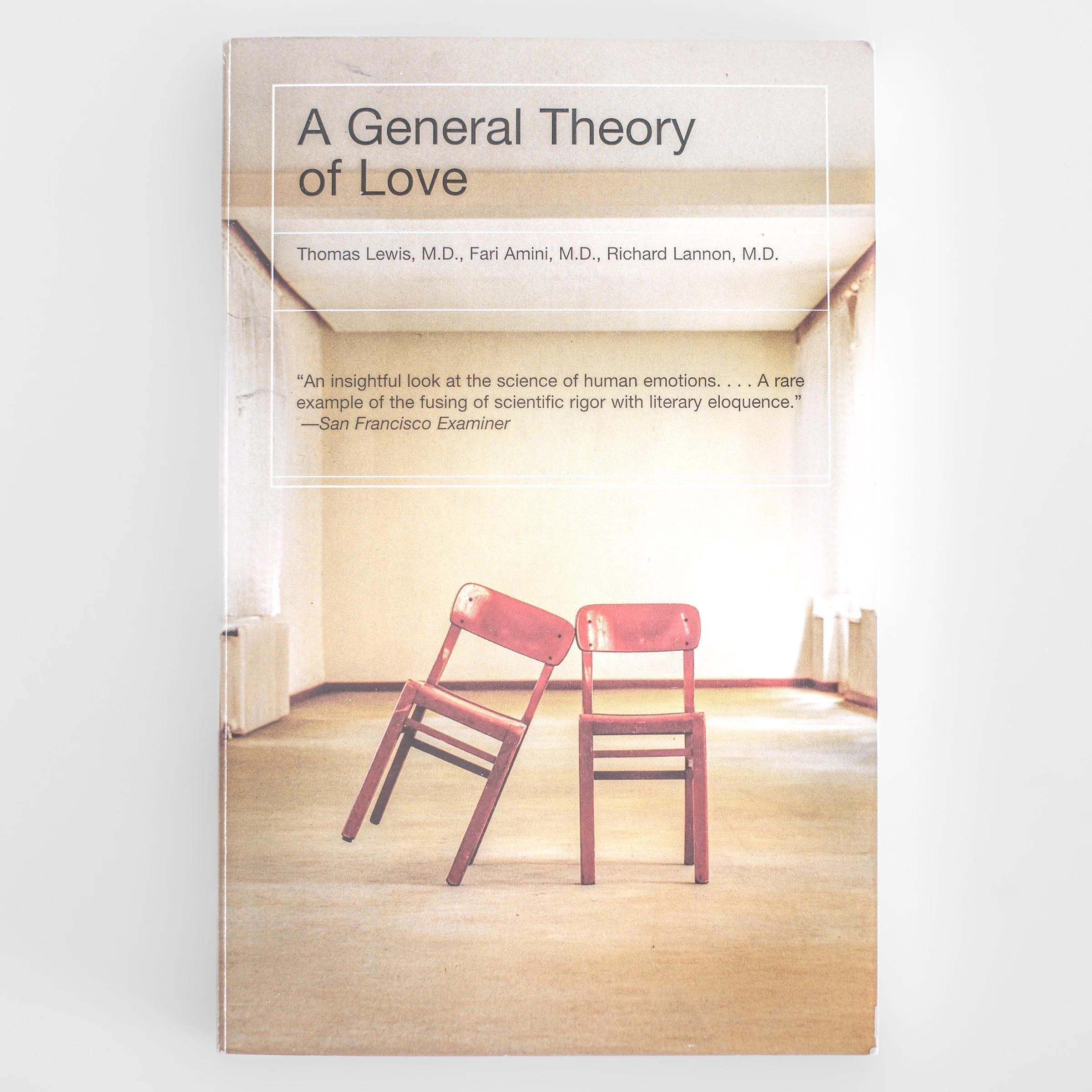
Out of all the books in the world, this is the one I currently most ardently wish existed in Polish. This is because some people I hold very dear don’t read books in English—and several among them seem to me to be this book’s intended audience. How satisfying it would be to share my reader experience in more than my own words! This post is of course no substitute, since my blog is in English, but it’s the only platform I’ve got, so here’s where I’m posting. Posting what? A request. Namely, that a Polish publisher take an interest in A General of Love by Thomas Lewis, Fari Amini, and Richard Lannon—all of them M.D.s, though their book might make you think they devoted their lives to literature.
What’s most remarkable about this read—besides the beautiful writing that never for a moment neglects form as it’s expediting the lessons—is that it first came out in the year 2000. I’m astonished that a book first published twenty-six years ago is as timely today as it gets. And not just timely, either, but profoundly so. Instead of predating a field it helped map it seems more like a present-day culmination.
This book is a pioneering work of what we now refer to as “attachment theory”—so pioneering, in fact, that none of the jargon we associate with the topic is even there. For a reader today committed to overcoming her own attachment challenges in midlife, A General Theory of Love is both original source material and a ”therapese”-free investigation into the connection between safety in childhood and one’s lifelong capacity to form satisfying relationships. To call it a sleeper hit is to miss, however, since when it came out A General Theory caused quite the uproar (the Vintage edition I’m holding is the 30th printing—from 2001).
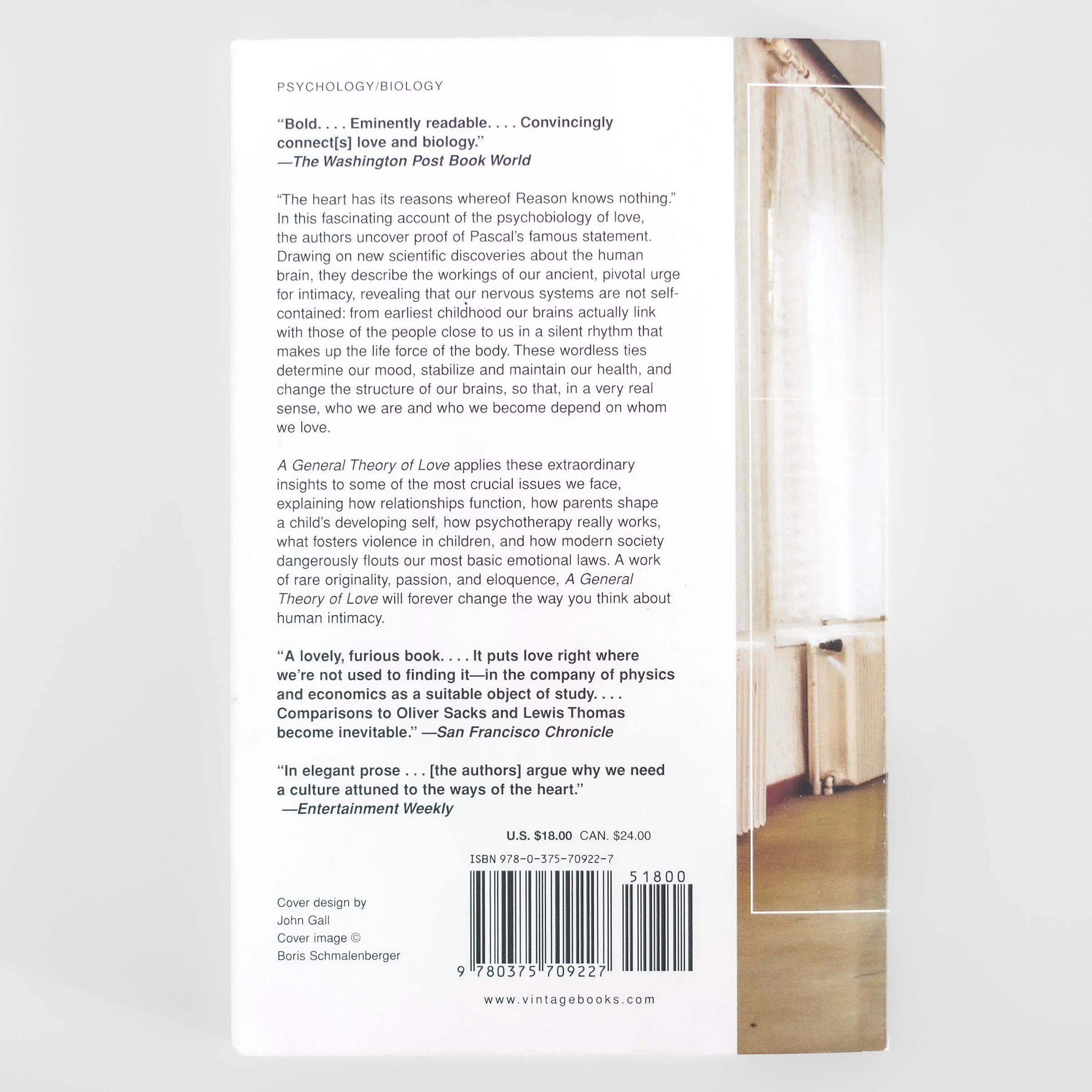
I reached for this book because I trust my friend Magda, the person who told me about it and offered to let me borrow her brand-new copy. I also loved the poignant-yet-whimsical cover design (by Mercedes Everett and Lisa Motzkin), the feel of the lightweight small-format paperback in my hands, and the bookish yet friendly serif font of the main text against the warm off-white paper. (Of course I judge a book by its cover! The way I see it, that’s what the cover is for.)
To say that I learned a great deal as I read A General Theory (maybe even helped loosen some of my stuckest “core beliefs”?) is to leave out how enthralled and inspired I was on every page in response to the language itself. I read the whole thing pencil in hand, invited by Magda to mark up her book, so that when she reads it I’ll be there, waiting, whispering things and delighting at my favorite parts. In addition to the many important revelations I underlined about the love’s structures and childhood attunement and the ways we sometimes must adapt to the absence of what we urgently needed, I also underlined words and phrases that elicited in me the feelings poetry elicits. It was as if reading about the life sciences while moved by a kind of art helped me not just grasp new ideas but also allow them to transform me. Maybe there is a corollary here to learning how to self-soothe while bathed in parental love.
May this suffice as my review or, rather, recommendation. All that’s left to include is a sampling of the passages I so joyfully underlined in Magda’s copy of this timeless, timely, and tender book.
Some of My Favorite Passages in A General Theory of Love
Page 4: Poetry transpires at the juncture between feeling and understanding—and so does the bulk of emotional life.
Page 10: First, a curious correlation has prevailed between scientific rigor and coldness: the more factually grounded a model of the mind, the more alienating. Behaviorism was the first example: brandishing empiricism at every turn, it was thoroughly discomfiting in its refusal to acknowledge such staples of human life as thought or desire. Cognitive psychology bristled with boxes and arrows linking perception to action and had nothing to say about the unthinking center of self that most people cherish. Evolutionary psychology has shed welcome light on the mind’s Darwinian debts, but the model declaims as illusions those features of human life lacking an obvious survival advantage—including friendship, kindness, religion, art, music, and poetry.
Page 21: Evolved structures answer not to the rules of logic but only to the exigencies of their long chain of survival victories.
Page 26: Play is physical poetry: it provides the permissible way, as Robert Frost said poems do, of saying one thing and meaning another.
Page 81: Science is an inherent contradiction—systematic wonder—applied to the natural world.
Page 93: Early nurturance can stretch forward in time to insulate adults from the destabilizing pangs that solitude brings.
Pages 95-96: Psychiatrists often see people who deliberately injure themselves in minor but stinging ways—like making shallow razor cuts to the forearm or cigarette burns to the thigh. […] Most of them have one thing in common: an exquisite, lifelong sensitivity to separation’s pain. The miniature losses contained in a rebuke, a spat, and other transient relationship rifts can arouse in them an unbearable blend of despondency and grief. Then follows an episode of self-harm—a prick, a burn, an incision into the skin. Beneath and within the abused epidermis, palpitating pain fibers send their drumbeat signal to the brain, warning of damage. These messages release pain’s counterweight: the blessed, calming flow of opiates, and thus, surcease of sorrow. Chronic self-mutilators provoke the lesser pain to trick their nervous system into numbing the unendurable one.
Page 116: The frustrating illegibility of love’s book is, as software makers say of problems with their programs, a feature and not a bug.
Page 141: Computer-based neural network programs are structures whose memory mechanism reduces experience into compact, occasionally fallacious expectancy. So, too, are we.
Page 222: Even while traditional medicine eschewed traditional aspects of healing […] “alternative” healers proliferated in response to the demand for a context of relatedness. These limbically wiser settings are friendlier to emotional needs—they involve close contact with someone who participates in close listening, and often, the ancient reassurance of laying [one’s] hands [on the patient’s body]. Alternative medicine sees these activities as quintessential rather than incidental to healing.
Endnote
Excerpts have been transcribed manually with no electronic assistance. They are from the first Vintage edition, paperback, printed in the United States in 2001 (ISBN 0-375-70922-3).