Who wants to trust me on this?
I may live under a rock in more ways than one, but capitalism calls to me, too. On Vinted, most unavoidably, where every item I sell is a stroll past hundreds of items a lot like the stuff I’ve clicked on—and often bought—in the past. What a killing they make—monetizing instant gratification and the addictive contradictory highs of decluttering and bargain hunting balled up into one false promise of sustainability, likely a laughable conceit given the shipping footprint involved. And how about I don’t even mention the customer service?
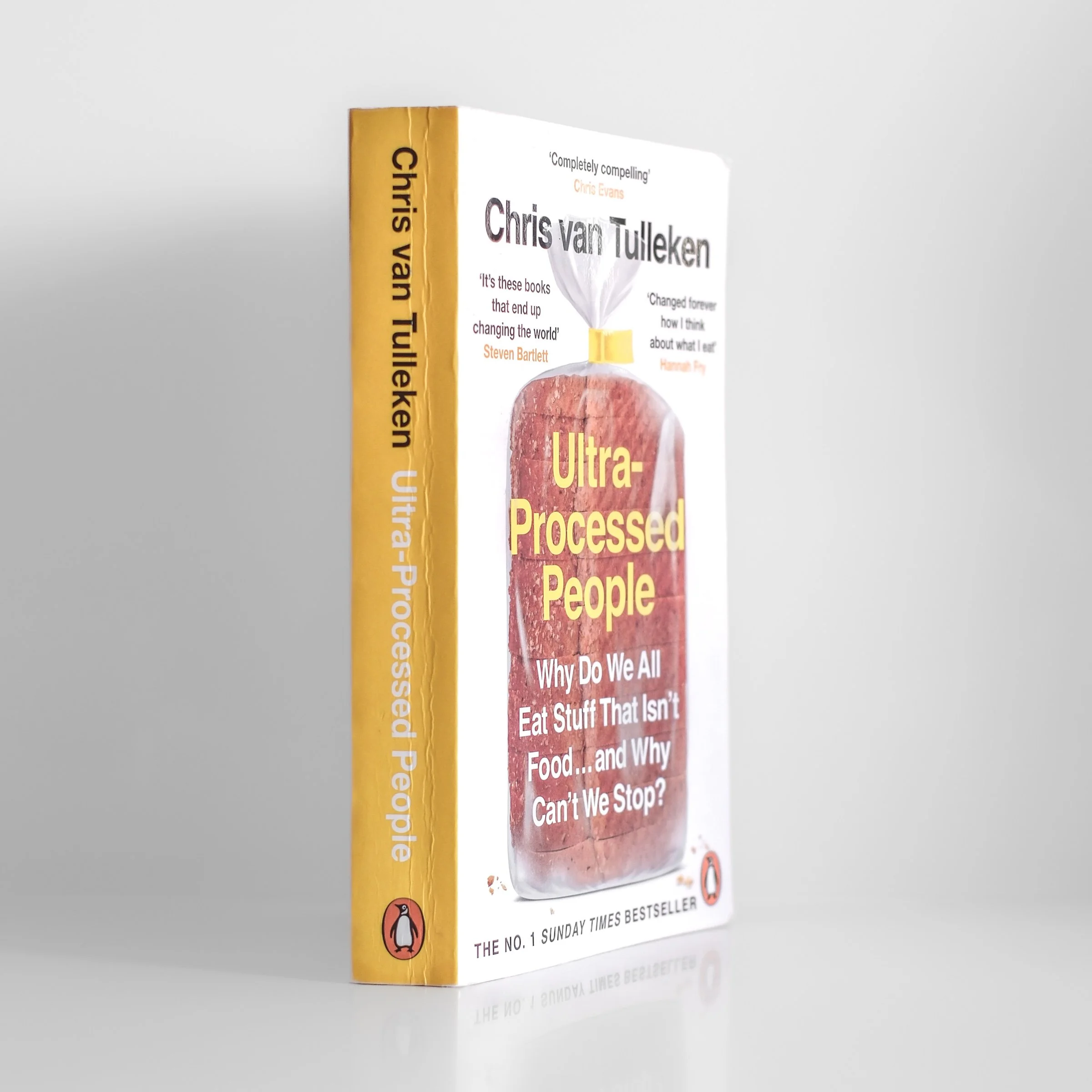
Am I recommending a book by first griping about Vinted? Yes, I am. See, I first came across Tulleken’s book while on the platform, and kept seeing it there while administering to the sale of many a non-joy-sparking item. The clever cover art and terrific title immediately caught my attention, and eventually I wound up on American Amazon, reading a sample (because the other Amazons rarely offer one and the dot-com one rarely doesn’t). It was clear this was at the very least a book with a gripping and well-written introduction. And while I didn’t feel it would have much to teach me—who buy and eat even less ultra-processed-food now than has already been the case for decades—I imagined it a great idea to offer this treatise against Big Food to my impressionable teenage son.
I kept my eye out for a sensibly priced used copy on Vinted, but eventually went with the wonderful online shop of Libristo because of the risk—both on Vinted and on Amazon—of ordering a fulfillment-center reprint on reprehensible paper. At the time I had no words to describe what I’m describing. Now, however, I would describe this kind of book as ultra-processed. I’ve seen reviewers on Libristo criticize the time it takes for an order to be fulfilled—and I gave them all the stars for this very reason, because I know they’re about to send me the real deal from the actual publisher. The paper quality, the print layour, the cover texture, even the smell—all this needs to come with a certificate of authenticity or a warning.
When Tulleken’s book arrived I dug in promptly, expecting to read a bite or two, skim the rest, and hand things over to Anker. Instead, I had in my hands a true page-turner, one thoughtfully written and filled with insights applicable not just to eating habits in the modern era but also to matters of dietary health (or dietary disease, as is so often the case), as well as to the universal drama of consumer choice under global capitalism. Even the parts I expected to find unpalatable—pertaining to the author’s own “scientific” UPF-only diet—were warranted and illuminating, cautionary tales each and all.
I mentioned one way I might compare a book to UPF. Here is another: some books these days are nothing but a good idea neatly marketed. This has been true for years, but it’s only gaining momentum as AI-based writing infiltrates even “real” writing, that is, that of books. Hollow inside and repetitive, but offering such promise that sometimes you read the whole thing before admitting that it never delivered on those shiny sample chapters. I recall a buzzy book from a few years ago that exemplifies this problem well—something about breath, accordingly titled. When I was ordering the Tulleken book I knew what I was risking. Find a nourishing, satisfying—helathy?—read was irony and metaphor and golden luck.
[Post under construction, to be continued!]