I may live under a rock in more ways than one, but capitalism’s irresistible gleam blinds me, too. Most unavoidably on Vinted, where every item I sell is a stroll past hundreds of items a lot like stuff I’ve clicked on or bought. What a killing they make—monetizing instant gratification and the addictive contradictory highs of decluttering and bargain hunting, the two balled up into one false promise of sustainability, likely a laughable conceit given the digital and shipping footprints involved. How about I don’t even mention the bot-led customer “service”?
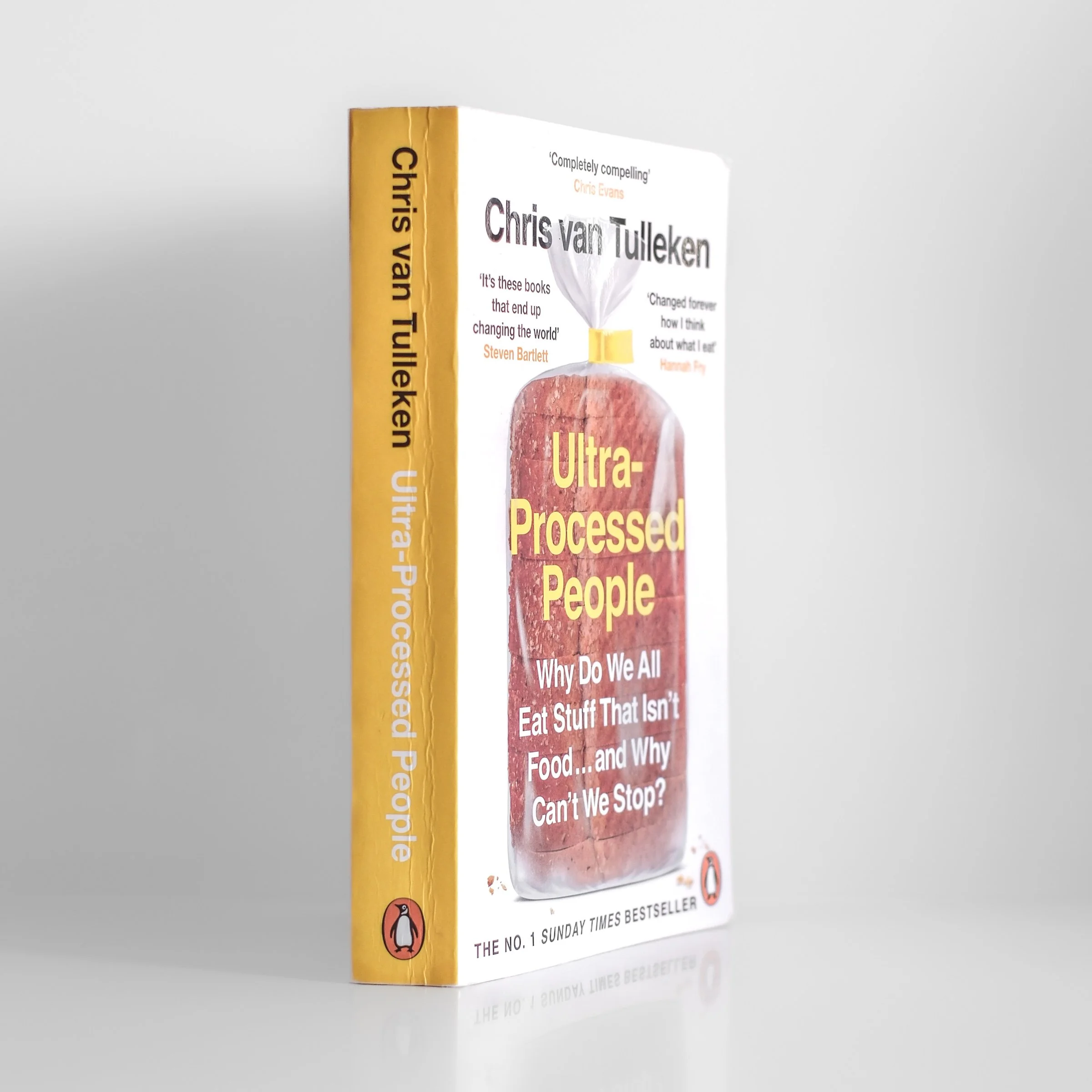
Am I recommending a book by first griping about Vinted? Yes, I am. It’s where I first came across Tulleken’s book and that’s where it kept popping up while I administered to the sale of many a non-joy-sparking item. The clever cover art and terrific title spoke to me, so eventually I wound up on American Amazon, reading a sample (because the other Amazons rarely offer one and the dot-com rarely doesn’t). It was clear this was at the very least a book with a gripping and well-written introduction. And while I didn’t suppose it would have much to teach me—who buy and eat even less ultra-processed-food now than has already been the case for decades—I wanted to offer this fast-paced thriller of a case against Big Food to my impressionable teenage son.
I kept my eye out for a sensibly priced used copy on Vinted, but eventually went with the wonderful online shop Libristo because of the risk—both on Vinted and on Amazon—of receiving a fulfillment-center bootleg on reprehensible paper. (“Printed in Poland by Amazon fulfillment” such a copy might discreetly announce at the bottom of the last chalk-white page, next to the flimsy plastic-coated back cover.) I’ve seen reviewers on Libristo criticize the time it takes for an order to be fulfilled—but I actually honor the wait, because I know they’re about to ship the real deal from the actual publisher. The paper quality, the print layout, the cover texture, even the smell—all this should come with a certificate of authenticity nowadays, or with a warning. I now refer to these knockoff books as ultra-processed.
When Tulleken’s book arrived I dug in promptly, expecting to read a bite or two, skim the rest, and hand things over to Anker. Instead, I had in my hands a true page-turner, one thoughtfully written and filled with insights applicable not just to eating habits in the modern era but also to matters of health/fitness and the universal drama of consumer choice (and lack of it?) under global capitalism. (Or is it technofeudalism? I have another book on the way to sort that.) Even the parts I expected to find unpalatable—pertaining to the author’s own “scientific” course of eating pure UPF, thankfully cut short—were warranted and illuminating, cautionary tales each and all.
I mentioned one way I might compare a book to UPF. Here is another: many books now are little more than a good idea neatly marketed. This has been true for years, but it’s gaining momentum as AI infiltrates even the “real” writing of non-fiction books. Hollow inside and repetitive, books of this sort offer such promise that sometimes you read the whole thing before realizing that this should have been an Instagram carousel. I recall a buzzy book from a few years ago that was like this—something about breath, accordingly titled. The author there also did things to himself in order to boost his cred. As I was ordering the Tulleken book this was the risk I was taking. Finding a nourishing and satisfying read instead was delicious irony and apt metaphor and golden luck. And to discover that this book, too, ties in to my recent Kujawa-reading experience? Icing on the cake, I’m telling you.
Originally I was going to extract some sample excerpts, as I did with A General Theory of Love, but Tulleken’s book is off traveling with my son and all I managed to get before he left was the photo. For an excerpt you can visit the “UPF of the web” that is the original dot-com Amazon site, but if you’re interested in the points and themes I found most transformative and interesting (spoilers, some of them), read on.
What is UPF? How is this even defined? This turns out to be a fascinating analysis that right away sets up the anchoring themes of nutrition and policy—and the indivisible connections in question. The body versus culture, nature and nurture, it’s all here. Here’s an example of the complexities involved: even though refined seed oils are—in terms of both food processing and digestibility—egregiously ultra-processed, in population studies the purchasing and use of these “foods” in the household counts as evidence of non-UPF dietary patterns, since clearly actual cooking is taking place.
Are calories simply calories? Apparently not. Whole foods are metabolized very differently than isolated and manufactured substances and the “foods” constructed from such “ingredients.” The author describes how the body reacts to not just apple juice versus a whole apple, but even to the same whole apple mechanically transformed into a smoothie for immediate consumption. I expected there might be a minor difference, but it turns out the difference is decisive.
By the same token, are nutrients simply nutrients? Nope. It turns out that the supplements some of us so diligently take along with our minimally processed organic meals are leaving their UPF footprint on our eating habits and on our bodies. According to research cited by Tulleken, even probiotics are likely doing nothing beneficial. Basically, if it isn’t a basic cooking ingredient and it’s not a whole food—it’s UPF. Since reading Tulleken I’ve pretty much quit supplements, some I’ve been taking on and off for years—D and K, B12, and the like. Some weeks later, I noticed the numbness and tingling in my hands was gone at last. Could it have been a B-family isolate messing with the nerves it was theoretically supporting? While Tulleken lays out how causation can almost never actually be proven—no study ever conclusively found that cigarettes “cause” disease—extrapolating judiciously from correlations is of course encouraged. It’s worth mentioning that I have been TILT-ed—medication gives me paradoxical effects and apparently this includes “innocent” supplements. When I re-tried magnesium at bedtime at one point, I woke up with puffy eyes and brain fog on the three mornings following my tentative dose.
In fact, the book seems to confirm that a totalitarian approach to avoiding UPF is both visionary and reasonable. What even I used to think might be some kind of orthorexia now seems self-affirming and cooly anti-corporate. And certainly invites me to put even more faith in my intuition—while spending less than ever on supplements and “superfood” isolates.
Tulleken describes an improbable study performed over many months one century ago, in which small children were offered, at every meal, a choice of dozens of natural freshly prepared separate whole foods from every category—a range of raw and cooked fruit and vegetables, grains and starches of all kinds, edible fats, a selection of meats and organ meats, dairy and eggs, and so on. This was “baby-led weaning” at its most utopian and Tulleken marvels at how it was even possible to sequester so many children for so long and apparently not wound them relationally in the process. Anyway, the takeaway is that all these kids cured themselves of practically every ailment they had arrived with. One pre-verbal boy healed his rickets by slamming cod liver oil by the shot glass over a course of weeks. Of note was a tendency to what the experimenters (devoted defenders of appetite as wisdom?) termed “jags”—periods of concentrated consumption of a single food, one apparently urgently needed by the body.
How about those food choices, then, are we to be trusted with our cravings? Not where UPF is involved, because the disconnection between flavor signal, food texture, branding power, and macros delivery is deleterious. But if a food is a whole food and we’re embodied enough to recognize what we want—there may well be no better “dietary guideline” or “food plan” than to follow these urges. I’m on a hulled hemp seed jag as I write this, though in the past I would have been swayed by a rational-sounding “nah, I had that yesterday.”
What about exercise, metabolism, and eating for fitness? There’s lots on this, too. What stayed with me was a thought experiment about a place for faking the activities of office work—people clacking on toy keyboards, talking into props that look like phones. A fun read, it was the setup for considering gym workouts and organized sports as simulacra of savannah life—the UPF equivalent of the movement and physical exertion that would come with living mostly outdoors in community and in nature. The implications this has for my lifestyle are explosive.
I feel that I’ve shared quite a lot of what I found riveting, yet I haven’t even gotten to the bones of Tulleken’s book—the matter of industry, marketing, profit, corporate interest, and the predicaments that ensue when regulators and purported consumer interest groups maintain conflicts of interest. I won’t compress the enormity of all this into key takeaways, but I do want to emphasize that Tulleken’s evidence is impressive here, as well as applicable to other industries that make “good for you” claims about practices, products, and precedents that cause injury to bodies, societies, and ecosystems. Before reading Tulleken I was stumped by a question I had come across on a fragrance-free advocacy forum: can an organization for chemical sensitivity accept a named donation from a scented products manufacturer’s fragrance-free subsidiary? Having read Ultra-Processed People I understand it’s wise not to: activism can quickly get quashed or discredited by donors profiting from the stuff you oppose.
For the author’s impressive abundance of sources there’s the book, which I recommend reading in the updated version, since the two chapters added in 2024 include a recursive look at the book’s initial impact and proposals for policy change—and both are excellent.
That’s all. My third book recommendation in three months, a neat way to hone a new set of skills while staying quiet about my private life. I hope I’ve been able to convey the way Tulleken manages to blow the whistle on terrible things while giving the reader a reason for optimism. I also hope that many, many people read this book.